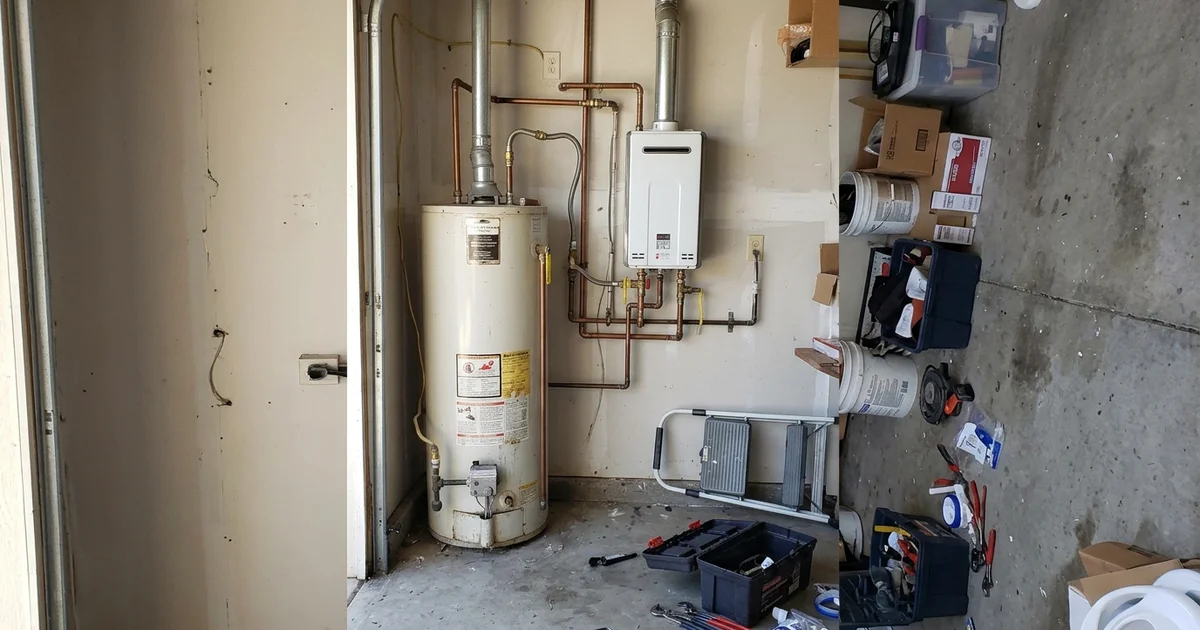
Most tank-versus-tankless comparisons focus on purchase price and endless hot water. In Lake Havasu City a third factor matters just as much: the water is hard, and that changes how each type wears out. Choosing between them is partly choosing which kind of maintenance you would rather do, and who will do it.
How each one wears out on hard water
A tank collects sediment on the bottom. The layer insulates the burner, the steel overheats and eventually the tank corrodes through, usually at the bottom seam. It is a slow decline, managed with a yearly flush and anode checks, and it is fairly forgiving if you are a little late.
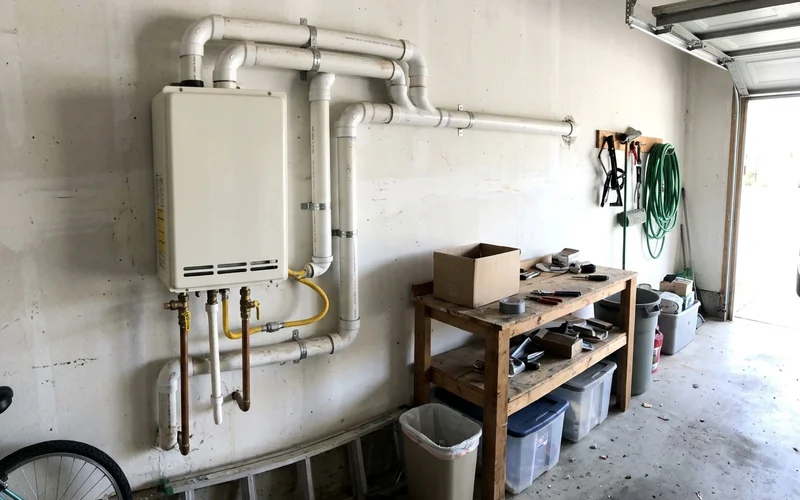
A tankless unit heats water inside a narrow heat exchanger. Scale builds in those passages, efficiency drops, temperatures swing, error codes appear and eventually the exchanger can fail. It is much less forgiving. A skipped descaling shows up quickly.
Compared on the criteria that matter
| Criteria | Tank | Tankless |
|---|---|---|
| Upfront equipment and install | Lower | Higher, more if gas line or venting must change |
| Install complexity on a swap | Usually straightforward | May need a larger gas line, new venting and power |
| Standby energy loss | Some, keeping the tank hot | Minimal; heats on demand |
| Hot water supply | Limited by size and recovery | Continuous at rated flow |
| Hard-water maintenance | Yearly flush, anode check every two to three years | Descaling at least yearly untreated |
| Tolerance of skipped maintenance | Fairly forgiving | Not forgiving |
| Typical failure | Tank leak | Scaled heat exchanger, error codes |
| Space | Floor space in a garage or closet | Wall-mounted |
| Best fit | Light to moderate use, simple ownership | High demand, long ownership, committed to maintenance |
Where the desert helps tankless and hurts tanks
A tankless unit’s output depends on how much it has to raise the water temperature. Supply water in Lake Havasu City runs warm through much of the year, so the temperature rise is smaller and the same unit delivers more flow than a national sizing chart assumes. You may need a smaller model than you expect.
The heat cuts the other way for tanks in garages. A tank sitting in a garage far hotter than 110 degrees still cycles against daily demand, and the warm, mineral-heavy water entering it is already close to dropping scale.
Who uses the house changes the answer
| Household | Usually the better fit | Why |
|---|---|---|
| Full-time family, several people | Tankless with a softener | Steady high demand, someone home to keep up maintenance |
| One or two full-time residents | Tank | Lower demand, simpler ownership |
| Second home used a few months a year | Tank, set to vacation when away | Little benefit from tankless, fewer things to maintain |
| Short-term rental with frequent full bookings | Tankless if maintenance is scheduled; otherwise a larger tank | Back-to-back showers, but someone must own the descaling |
A quick checklist
Lean tank if most of these are true:
- You want the simplest, most forgiving maintenance.
- The house is part-time or has one or two residents.
- You need hot water back fast and the current setup is a straight swap.
- You may sell within a few years.
- You are not adding a softener.
Lean tankless if most of these are true:
- Several people run back-to-back showers and appliances.
- You plan to own the home for many years.
- You have a softener, or will add one.
- You will actually schedule yearly descaling.
- You want the floor space back.
Local expert insight
A tankless system on this water works well with a descaling schedule and ideally a softener upstream. Without them it underperforms and fails early. That is not a knock on the technology; it is what hard water does. See tankless descaling frequency for realistic intervals.
Sizing in brief
- Tank: look at your busiest hour. Two showers plus a dishwasher on a full-house morning sets the demand. Tank size plus recovery rate has to cover it.
- Tankless: add up the gallons per minute of fixtures likely to run together, then match that to the unit’s output at your temperature rise.
Before you book
Switching to tankless can involve gas, venting and electrical changes, and some water heater work may need a permit. Ask whether one is required and whether it and any upgrades are in the estimate. Our water heater repair and replacement service covers gas, electric and tankless. Call Lake Havasu Plumbing Pros at 928-555-0100 at any hour. Tell the automated bilingual assistant how many people use the home, whether it is full-time or part-time and whether you have a softener. Request a free estimate and ask about any service call fee before booking.